


In the mining world, where every decision can make or break an operation, having the skills to implement projects effectively is like striking gold. Imagine the chaos if your machinery needs to be updated, safety protocols are just for show, and new initiatives are only discussed in meetings but never implemented. It’s a recipe for disaster. That’s why practical implementation skills are so crucial.
Let me paint you a picture. You’re deep in the heart of a mining operation. The stakes are high, the investments are massive, and there’s no room for error. Now, think about what happens when a project is handled poorly. Delays, overspending, and safety risks become the norm. But when projects are executed well, completed on time, within budget, and meet all the necessary safety and regulatory standards, it slashes risks, boosts profits, and helps mining companies stay innovative, competitive, and trusted by stakeholders. Plus, it keeps employees motivated and fosters a culture of sustainability.
The traditional approach: a double-edged sword
Now, let’s talk about how things usually go down in the mining industry. Many operations rely on the principles of Project Management Body Of Knowledge (PMBOK). You might have heard of this approach, where projects are meticulously planned and executed through phases like initiating, planning, executing, monitoring, controlling, and closing. It’s a solid method, mainly when projects are managed by dedicated teams who do nothing but focus on project management.
But here’s where it gets tricky. In the real world, especially in mining, projects often fall into the lap of operations managers juggling a million tasks. These managers are expected to implement new initiatives as part of their day-to-day activities, so these projects often get pushed to the bottom of the priority list. The result? Many projects fail to take off because operational duties take precedence.
Imagine being an operations manager. You’re dealing with daily production issues, meeting safety standards, and handling workforce challenges. On top of all this, you’re now expected to implement a new project. It’s a daunting task. Accountability for these projects falls squarely on your shoulders, with some support from functional staff. But, let’s be honest, with so much on your plate, these projects often don’t get the attention they deserve. This is where things start to fall apart.
The Demand Triangle: a game-changer
Enter the Demand Triangle, a tool that’s as simple as it is powerful. This little gem can make a difference by clarifying interactions between different parties involved in a project. It’s designed to guide managers at all levels towards a sustainable project delivery success rate of 80% or higher. Sounds too good to be true? Stick with me.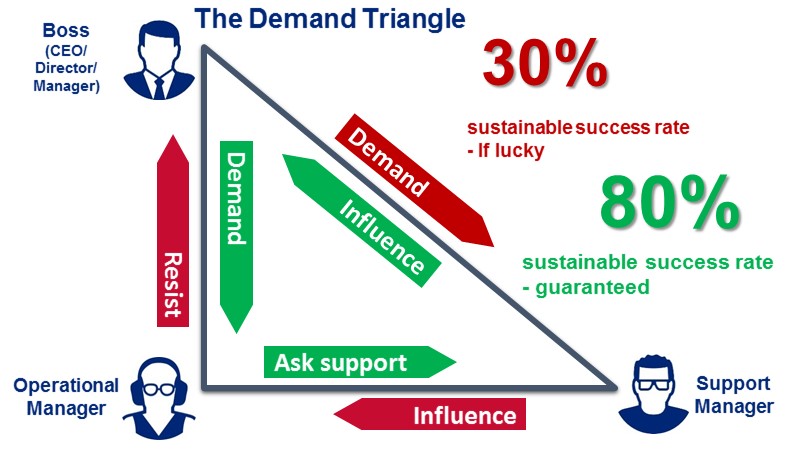
The Demand Triangle isn’t some complex, convoluted framework. It’s straightforward to grasp, which is part of its charm. Picture a triangle. At the top, you’ve got the boss—this could be the CEO, Director, or General Manager. Basically, anyone who has subordinates. On the bottom left, there’s the Operational Manager. This person is knee-deep in the daily grind, like a Production Manager. And on the bottom right, you have the Support Manager, someone like a Business Improvement (BI) Manager, whose job is to provide support and expertise.
The red arrows: where it goes wrong
Here’s where many organisations trip up. In most cases, the boss makes demands directly to the Support Manager. The logic? The Support Manager is seen as the professional in charge of improvements, so they should handle it. The Support Manager, eager to please, then tries to influence the Operational Manager to get things moving. They use various change management techniques to persuade the Operational Manager. Sometimes, the Support Manager, like a corporate office or a consultancy, comes from outside the operation and has to build relationships from scratch to have any influence. This process can be time-consuming and challenging.
When the boss requests progress updates, the Operational Manager often resists. This resistance can be active (clearly stating reasons like a lack of resources or support) or passive (nodding in agreement but secretly sabotaging progress). As a result, progress is slow or non-existent. The boss then increases the pressure on the Support Manager, demanding more resources, tools, and support to gain traction on the project. This cycle repeats until the project fails dismally or is completed late and possibly irrelevant by then. Projects following these red arrows have a low success rate, around 30%.
Following the red arrows can have dire consequences. It destroys professional relationships and gives the operation a reputation for not delivering on promises. Sadly, this approach is widespread and driven by organisations as the way to implement improvement projects. They often say they want Operational Managers to focus on core activities and leave improvements to the professionals, but this removes ownership from those who should be driving the project, leading to sterile projects or limited benefits. The opportunity to make continuous improvement a core competency is missed.
The green arrows: the path to success
Now, imagine flipping this script. The boss directs their demands to the Operational Manager instead. This creates a sense of ownership and accountability. The Operational Manager feels responsible and likelier to be passionate about the project. The Support Manager’s role then becomes one of providing assistance when requested, not pushing for changes. This approach, represented by the green arrows, significantly increases the chances of project success.
In the next part of our journey, we’ll explore the dynamics of the Demand Triangle and practical examples of how it can transform project implementation in mining. Trust me, you won’t want to miss it.