


Welcome back to our exploration of the Demand Triangle, a crucial tool in the mining industry! We’ve covered why effective implementation is paramount in mining and how the Demand Triangle can revolutionise project success. Now, let’s delve into the practical steps of planning and navigating these triangles to ensure your initiatives run smoothly and efficiently.
A. Drawing up your Demand Triangle
When embarking on a new project, the first step is to draw up a Demand Triangle for each initiative. This helps you visualise the roles involved and ensures that demands are directed appropriately. Here’s a quick overview of the steps we’ll be discussing.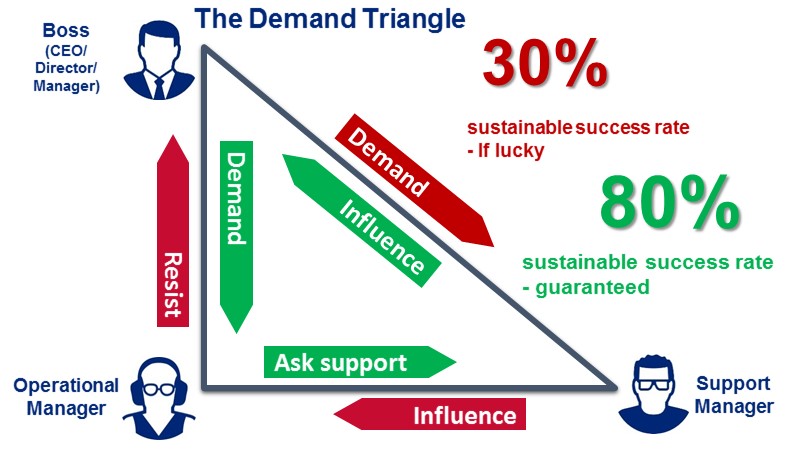 Step 1: Identify key stakeholders
First things first, let’s know the key players in your project. Every project will have three key roles within the Demand Triangle, each with their unique responsibilities and contributions:
- The Boss: This could be the Mine Manager or a Senior Executive, someone with the authority to initiate projects.
- The Operational Manager: Typically a Production or Site Manager responsible for daily operations.
- The Support Manager is usually a Business Improvement Manager, Finance Manager, or another role providing necessary support.
Step 2: Establish clear communication channels
Next, ensure clear lines of communication between the Boss and the Operational Manager. The Support Manager should facilitate these communications, offering assistance without overshadowing the operational manager’s primary responsibility.
Example: For a project to reduce equipment downtime, the Mine manager (Boss) should tell the Production Manager (Operational Manager) what’s needed. The Maintenance Manager (Support Manager) should be ready to provide technical support when called upon, but not before.
Step 3: Create a Demand Triangle for each initiative
Now, draw a Demand Triangle for each project. Clearly mark the roles and flow of demands using green arrows to show the direct demands from the Boss to the Operational Manager. This visual representation helps keep everyone aligned on who is responsible for what.
Example: In your diagram, place the Mine Manager at the top, the Production Manager at the bottom left, and the Maintenance Manager at the bottom right. Draw a green arrow from the Mine Manager to the Production Manager.
B. Navigating the triangles
Once your Demand Triangle is set up, you must navigate the complexities that arise during implementation. Here are some key strategies to ensure smooth sailing.
Rule 1: Direct demands properly
Ensure the Boss directs demands to the Operational Manager, creating a sense of ownership and accountability. This empowers the Operational Manager, making them feel valued and integral to the project’s success. The Operational Manager will feel responsible and more motivated to progress the project.
Example: The Mine Manager tasks the Production Manager with reducing equipment downtime. The Production Manager now owns this task and is more committed to its success.
Rule 2: Offer support only when asked
The Support Manager should step in only when the Operational Manager asks for help. This keeps the Operational Manager in control and ensures they maintain ownership.
Example: The The Production Manager requests specific tools or training to tackle downtime. The Maintenance Manager provides these resources without taking over the project.
Rule 3: Influence upwards, not sideways
If demands aren’t appropriately directed, the Support Manager should guide the Boss in redirecting them correctly. This must be done subtly to avoid appearing to undermine the Operational Manager. Building a strategic, consultant-client relationship with your Boss helps nurture this dynamic.
Example: If the Maintenance Manager notices the Mine Manager bypassing the Production Manager, they should advise the Mine Manager to direct demands to the Production Manager.
C. Applying the rules in real life
Let’s look at a real-life scenario to see how these rules play out in practice.
Scenario: Reducing operating costs
Context: A mining company needs to implement a project to reduce operating costs. The Boss drives this initiative, the Operational Manager is the Production Manager, and the Support Manager is the Finance Manager.
Planning Phase:
- Boss: Mine Manager
- Operational Manager: Production Manager
Demand Triangle setup:
- The Mine Manager (Boss) tells the Production Manager (Operational Manager) to reduce operating costs.
- The Finance Manager (Support Manager) stands ready to provide financial data, analysis, and support upon request.
Implementation phase:- Direct demand: The Mine Manager tasks the Production Manager with reducing operating costs. This direct demand creates a sense of ownership and accountability in the Production Manager.
- Support on request: The Production Manager identifies specific areas where cost savings can be achieved and requests detailed financial analysis and data from the Finance Manager. The Finance Manager provides the necessary support and resources, such as cost reports and budget analyses, without taking over the project.
- Influence upwards:
If the Finance Manager notices that the Mine Manager is bypassing the Production Manager and directly requesting financial reports or updates, they should remind the Mine Manager to communicate through the Production Manager. This ensures that the Production Manager remains the point of contact and retains control over the project.
Outcome:
The project to reduce operating costs progresses smoothly, with the production manager taking full ownership. The Production Manager integrates cost-saving measures into daily operations, with the Finance Manager providing the necessary data and support when requested. This collaboration fosters a sense of teamwork and shared responsibility, leading to timely and effective implementation of cost-saving initiatives.
D. Managing multiple Demand Triangles
In larger projects, you may be dealing with multiple Demand Triangles. This is especially true where off-site parties like corporate staff or consultants are involved. Here’s how to navigate this complexity.
Step 1: Draw multiple Demand Triangles
For each initiative, draw up separate Demand Triangles to visualise the different interactions and ensure all demands are correctly directed. This helps track who is responsible for what across various project parts.
Example: If your project involves both cost reductions and technology upgrades, draw separate Demand Triangles for each. One might have the Production Manager as the Operational Manager and the Finance Manager as the Support Manager, while the other has the Production Manager as the Operational Manager and the IT Manager as the Support Manager.
Step 2: Establish navigation rules
Set clear rules for how to navigate these multiple triangles, ensuring senior leadership supports these guidelines. This helps prevent confusion and ensures everyone knows their roles and responsibilities.
Example: Establish a rule that all demands related to cost reductions go through the Production Manager, while all technology upgrade demands go through the Production Manager as well, with support from the relevant Support Managers (Finance and IT Managers). Ensure these roles are respected throughout the project’s lifecycle.
Step 3: Apply the rules consistently
During implementation, regularly review the direction of the project and apply the rules as needed. If things don’t go as planned, it’s often due to a red arrow cropping up. Adjust accordingly to keep the project on track.
Example: If a red arrow appears, with demands bypassing the Operational Manager, address it immediately by redirecting them through the correct channels. This keeps the project aligned with the Demand Triangle principles.
Conclusion
For mining operations, successful project implementation is a top priority. While the “what” of projects is often well-defined, the “how” is where success lies. Applying the Demand Triangle provides a clear guide for planning and executing projects with sustainable improvement as the ultimate goal.
In essence, following the green arrows and adhering to the rules equips any operation with the tools to implement initiatives and foster continuous improvement. This structured approach enhances project success rates and builds a culture of ownership and accountability, driving long-term success in the mining industry. So, grab your Demand Triangle, map out your projects, and watch as your mining operation thrives.